
What Causes Ice Dams (And How to Stop Them for Good)
Step through an interactive cutaway and see the two fixes that end repeat ice dams.
Read more →Roofs in Tewksbury are built to a 50-pound-per-square-foot snow load, and a bad February tests every one of them. Here's what to check from the ground before the first freeze, and exactly what to do if water shows up mid-winter.
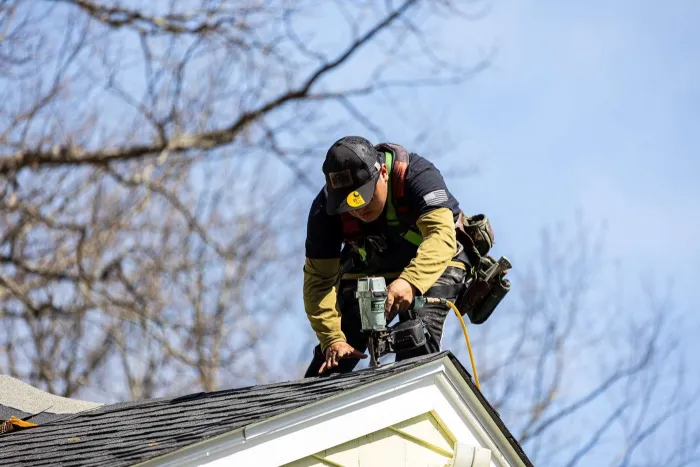
Stand across the street with binoculars if you have them, then walk the perimeter, then poke your head into the attic. You're looking for:
Anything on that list you're not sure about, our fall inspection is free. We look at the same things from the roof and the attic, and you get a plain answer about whether it's fine for winter, needs a repair, or is a replacement conversation for spring.
The Massachusetts building code sets a design snow load for every town. Tewksbury, Billerica, Chelmsford, and Lowell are all in the 50-pound-per-square-foot column, which is what a roof here is engineered to carry. That number covers a normal winter with a margin. What eats the margin is wet snow, which weighs three to four times what the same depth of powder does, and a string of storms with no thaw between them.
The rule of thumb: start paying attention after about six inches on the roof, and take it seriously after a foot of wet snow or repeated storms that stack up. Pull the lower three or four feet clear with a roof rake from the ground after any big storm; that removes weight at the eave and starves an ice dam of its raw material. Creaking, a ceiling that suddenly sags, or interior doors that start sticking are load signs, and they mean call now. Our snow load guide goes deeper, and our crews handle roof snow removal all winter with the right equipment.
When an asphalt roof is replaced in Massachusetts, the code requires an ice barrier at the eaves: a self-adhering waterproof membrane under the shingles, running from the roof edge up past the line of the exterior wall. Its whole purpose is ice dams. If a dam forms and water backs up under the shingles, it hits rubber instead of bare plywood and runs back out.
Roofs installed before that requirement, or installed without it, have no second line of defense. If your roof gets ice dams every winter and it's more than fifteen or twenty years old, the leak and the age usually get solved together. Every roof we install carries the ice-and-water barrier at the eaves and in the valleys, proper ventilation, and flashing that's sealed rather than caulked over; the details are on our roofing page.
It happens, and the order of operations matters.
Repairs run all winter. Full replacements get harder after late November because shingles need warmth to seal, so if the fall inspection says the roof is done, the right schedule is a permanent patch now and the new roof in spring.
Generally, homeowners insurance covers sudden damage: a tree limb, wind that lifts shingles, an ice dam leak that ruins a ceiling. It generally doesn't cover a roof that failed because it was old or wasn't maintained, and some policies pay less on roofs past a certain age. Every policy is different, so call your agent early, send the photos, and ask what's covered before any permanent work starts. We provide the written assessment and photos adjusters ask for.
If the inspection finds a few lifted shingles or a bad chimney flashing, that's a repair, and a fall repair is cheap insurance against a January leak. If more than about a quarter of the roof is damaged, or it's past twenty years, replacement is usually the better money; our guide to the 25% roofing rule explains how to make that call. Most asphalt roofs in Tewksbury run about $9,000 to $12,000, the instant roof quote gives you a real number in minutes, and financing starts at 0% for 12 months.
· 80 Google Reviews · 48-hour response on repair calls · Free, no-obligation. We reply within 24 hours.
Winter roof questions we get every year
Yes. Leak repairs, flashing, ice dam removal, and replacing wind-damaged shingles happen all winter, and we hold a 48-hour response on repair calls through the season. Some repairs get a proper temporary patch first, because shingles need warmth to seal and a full section can't be reworked in deep cold; the permanent repair follows on the first mild stretch. Full roof replacements get harder after late November for the same reason.
Usually when the cause is sudden: wind damage, a fallen limb, or an ice dam that pushed water into a ceiling. Usually not when the roof leaked because it was old or wasn't maintained, and some policies reduce what they pay on roofs past a certain age. Policies differ, so photograph the damage, call your agent before permanent work starts, and ask what's covered. We supply the written assessment adjusters ask for.
Start paying attention after about six inches of accumulation, and take it seriously after a foot of wet snow or repeated storms with no thaw between them. Wet snow weighs three to four times what the same depth of powder does. Roofs in Tewksbury and the surrounding towns are designed for a 50-pound-per-square-foot ground snow load, but creaking, a sagging ceiling, or doors that suddenly stick mean the roof is under real load and it's time to call.
Yes, from the ground, with a long-handled roof rake, after any storm that drops six inches or more. Clearing the lower three or four feet above the eave takes weight off the overhang and removes the snow an ice dam is built from. Leave an inch behind rather than scraping to bare shingle, and never do it from a ladder next to an icy roof. Two stories up, or heavy wet snow, is where you call a crew.